
Will Replacing People with AI Cost You Your Customers?
AI is changing the workplace at a speed most businesses could never have predicted.
Tasks that once took hours can now take minutes. Customer enquiries can be answered around the clock. Data can be analysed instantly. Emails can be drafted, meetings summarised and processes automated.
The efficiency gains are real.
But there is a question businesses need to ask before they automate their way into the future:
What happens when your customers stop talking to people?
AI is changing customer relationships
There is no doubt that AI has an important role to play in modern business.
For many organisations, it is already helping teams work more efficiently, reduce repetitive administration and respond to customers more quickly.
And that's a good thing.
Nobody wants to spend valuable time manually processing information that technology can handle in seconds.
But there is a difference between automating tasks and automating relationships.
A customer doesn't remember your business simply because you answered their enquiry in 12 seconds.
- They remember how you made them feel when something went wrong.
- They remember whether someone listened to their concerns.
- They remember whether they felt understood.
Customers still want human connection

Recent research continues to highlight the importance of human interaction.
Gartner reported in August 2026 that 87% of customers believe companies using generative AI for customer service should still provide access to a human agent.
That's an interesting statistic.
It doesn't suggest customers are rejecting AI.
Quite the opposite.
People are becoming increasingly comfortable with technology. They appreciate speed, convenience and having answers available whenever they need them.
What they don't necessarily want is for technology to become the only way they can interact with a business.
Especially when the situation becomes complicated.
If a customer has a straightforward question, an AI assistant may be absolutely perfect.
If their service has failed, they're unhappy with a contract, they're considering leaving or they're dealing with a complex issue, they may want something very different. They want someone to listen.
- Someone to understand the situation.
- Someone who can use judgement.
- Someone who can say: “I understand. Let me see what I can do.” And actually mean it.
The danger of replacing people rather than empowering them

This is where businesses need to think carefully about how they introduce AI.
The question shouldn't simply be:
“Which jobs can AI replace?”
A better question might be:
“Which parts of these jobs can AI improve?”
There is an enormous difference.
AI can take care of repetitive tasks, administration, data analysis and routine enquiries.
That can give employees something incredibly valuable back:
time.
- Time to speak to customers.
- Time to build relationships.
- Time to solve problems.
- Time to think strategically.
- Time to have the conversations that technology can't have for them.
Imagine a Customer Success Manager who spends half of their day manually producing reports, searching for information and updating systems.
Now imagine AI takes care of much of that administration.
The role hasn't necessarily become less important.
It could become more important.
That person now has more time to actually speak to their customers, understand their businesses, spot potential issues and identify opportunities to add value.
That's where AI can be genuinely transformative.
You can automate a transaction. You can't automate trust.
For businesses, this is perhaps the most important distinction. Technology can make an interaction quicker. It can make a process smoother. It can help employees make better decisions. But trust is built over time. It's built through consistency, understanding and experience. It's built when a client knows there is someone they can call when things aren't going to plan. It's built when a candidate has a recruiter who actually understands what they're looking for rather than simply matching keywords on a CV.
And it's built when people feel that they're being treated as individuals rather than numbers in a system.
This is why the human element of business isn't disappearing.
If anything, as AI becomes more prevalent, genuine human connection could become even more valuable.
What does this mean for recruitment?
The workplace is changing, and that means the skills businesses look for are changing too.
Technical ability remains important, but organisations increasingly need people who can communicate, build relationships, demonstrate empathy, think critically and work collaboratively.
These are the qualities that help businesses differentiate themselves.
And they are particularly important in customer-facing roles.
A business can have the best technology in the world, but if customers don't feel valued, understood or supported, technology alone won't save the relationship.
That's why recruitment needs to look beyond a CV. It's about understanding the person behind the experience.
- What motivates them?
- How do they communicate?
- How do they handle pressure
- Can they build trust?
- Will they fit the culture of the organisation?
- And, ultimately, will they make a positive difference to the customer experience?
The future isn't AI versus people
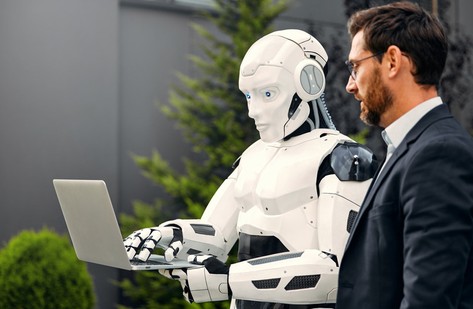
Perhaps the conversation shouldn't be about AI versus humans at all.
The future of work is much more likely to be about AI and humans working together.
The businesses that get this right will use technology to remove the repetitive elements of work while allowing their people to focus on the things that genuinely require human judgement and connection.
· They won't necessarily have fewer people.
· They'll have people spending more of their time doing the things that matter.
· And that's a future we can get behind.
At Clockwork Recruitment, people are at the heart of what we do, we understand that recruitment is about far more than filling a vacancy.
It's about people.
For our clients, that means taking the time to understand their business, their culture and the type of person who will genuinely add value to their team, not simply sending over a stack of CVs.
For candidates, it means understanding your experience, ambitions and what you're looking for in your next opportunity, rather than treating you as another application.
Technology can certainly help us work smarter and more efficiently.
But we don't believe it should replace the conversations, relationships and personal service that make recruitment work.
Whether you're a business looking to strengthen your team or a candidate considering your next career move, Clockwork Recruitment is always here to help.
Because while the world of work continues to evolve, one thing isn't changing:
People still want to work with people.
And that's something worth keeping human.


